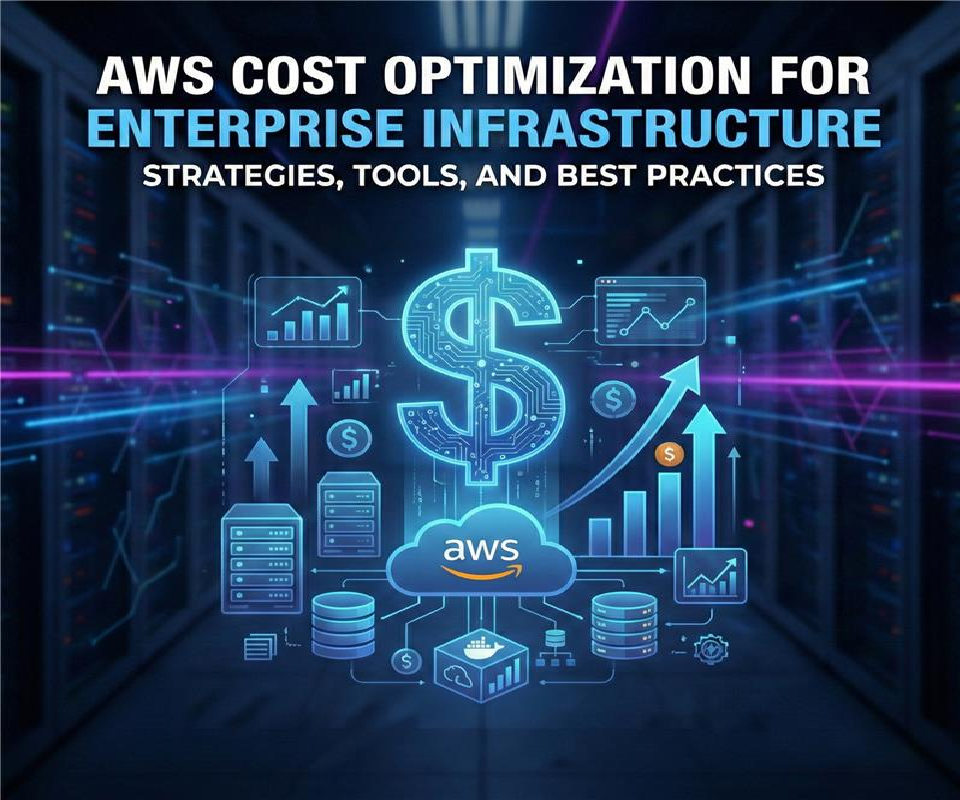
AWS Cost Optimization for Enterprise Infrastructure
Overview
Our team conducted a thorough AWS cost optimization initiative for an existing client with a mature, multi-service infrastructure spanning production and non-production environments. The goal was to reduce expenses across key services without compromising performance, compliance, or availability, achieving an estimated 35-50% overall cost savings through targeted rightsizing, lifecycle management, and commitment-based pricing.
Infrastructure Overview
Optimized an existing mature infrastructure spanning prod/non-prod environments.
- Multi-Environment Setup: Segregated prod (critical workloads) and non-prod (dev/test) for targeted optimizations.
- Compute Layer: EC2 fleets (rightsized + Graviton), ECS/Fargate clusters (Spot for non-critical, On-Demand for prod).
- Storage Layer: S3 buckets with lifecycle rules; EBS GP3 volumes; RDS with optimized snapshots.
- Managed Services: Redshift/OpenSearch clusters (RIs); NAT Gateways with PrivateLink endpoints.
- Governance: Centralized monitoring via Cost Explorer; IaC (Terraform/CloudFormation) for reproducible changes; tagging for resource ownership.
Client Profile
- Industry: Digital Health Technology / Remote Patient Monitoring (RPM) & Telehealth
- Region: North America
- HQ: Southwest USA (New Mexico)
- Operations: Nationwide
- Company Size: Mid-Sized Enterprise
- Staff: Approximately 200–300 employees.
- Scale: High-growth private company (Series D funded), currently managing tens of thousands of connected devices.
What They Do:
Core Business:
They provide comprehensive health technology solutions designed to help the elderly and chronically ill live independently (“aging in place”) while maintaining a digital connection to healthcare providers.
Key Innovation:
They are known for developing a proprietary Virtual Caregiver—an AI-driven, 3D animated avatar that interacts verbally with patients. This virtual assistant reminds users to take medication, guides them through physical therapy, and conducts health assessments.
Services:
- Remote Patient Monitoring: Capturing real-time vitals (blood pressure, glucose, etc.) via Bluetooth peripherals.
- Emergency Response: Providing mobile security and fall-detection systems.
- Predictive Health: Using data analytics to detect early signs of health decline and alert doctors before hospitalization is required.
Key Features
The project focused on no-regret quick wins, commitment-based pricing, and ongoing governance for sustainable savings.
- Rightsizing & Cleanup: Analyzed and resized EC2 instances, RDS databases, and storage; deleted unused EBS volumes, AMIs, snapshots, and Elastic IPs.
- Instance Migration: Shifted workloads to Arm-based Graviton instances (up to 40% better price-performance) and GP3 EBS volumes (~20% savings).
- Discount Strategies: Hybrid model of Convertible Reserved Instances (RIs) (up to 60% off), Compute Savings Plans for flexible overages, and Spot Instances for fault-tolerant workloads like ECS/Fargate.
- Storage Optimization: S3 lifecycle policies to Glacier/Deep Archive; reduced RDS snapshot retention in non-prod; cleaned up bloated logs (VPC Flow Logs, CloudTrail, ALB logs).
- Logging Reduction: Shortened CloudWatch log retention (~40% savings); standardized practices to minimize ingestion/storage.
- Data Transfer Savings: Used AWS PrivateLink to route internal traffic privately, reducing NAT Gateway charges.
- Automation & Monitoring: Monthly reviews with tagging for accountability; baseline analysis via multi-week usage monitoring.
Technologies Stack
Comprehensive use of AWS native tools for analysis, optimization, and implementation.
Category | Services & Tools |
Compute | Amazon EC2 (Graviton), ECS/Fargate (Spot/Graviton), Compute Optimizer |
Storage | Amazon S3 (Glacier/Deep Archive), EBS (GP3), RDS snapshots |
Databases & Analytics | Amazon RDS, Redshift, OpenSearch |
Networking | NAT Gateway, AWS PrivateLink |
Monitoring & Cost Tools | Amazon CloudWatch, AWS Cost Explorer |
Secrets Management | AWS Secrets Manager → SSM Parameter Store (free tier) |
DevOps | Terraform, CloudFormation, Python automation scripts, Docker |
Pricing Models | Reserved Instances (1/3-year convertible), Compute Savings Plans, Spot Instances |
Security Model
Security was not compromised during optimizations—focus remained on compliance while reducing costs.
- Data Protection Continuity: Retained encryption and access controls; lifecycle policies for S3 maintained compliance retention (e.g., Deep Archive for audit data).
- Secrets Migration: Non-critical secrets moved from Secrets Manager to SSM Parameter Store without exposing sensitive data.
- Private Networking: AWS PrivateLink ensured internal VPC traffic stayed private, avoiding public internet exposure and reducing data transfer risks.
- Access Controls: Tagging strategies enforced ownership and intent tracking; no changes to IAM policies or monitoring tools like CloudTrail.
- No-Downtime Approach: Optimizations (e.g., rightsizing, Graviton migration) were tested rigorously to maintain availability and security posture.
Data Types & Standards
Handled enterprise production data with emphasis on cost-effective storage and compliance.
Data Types:
- Application Logs: VPC Flow Logs, CloudTrail, ALB logs, CloudWatch—optimized retention and volume.
- Database Backups: RDS snapshots (reduced retention in non-prod).
- Object Storage: S3 data segregated by environment (prod/non-prod), transitioned to cost tiers based on access patterns.
- Secrets: API keys, credentials (migrated to cheaper storage).
Standards & Best Practices:
- AWS Well-Architected Framework (Cost Optimization Pillar).
- FinOps Practices: Tagging for cost allocation, monthly reviews, showback reporting.
- Compliance: Maintained audit-ready retention for logs/snapshots; no regulatory standards explicitly mentioned, but suitable for general enterprise (e.g., SOC2 via immutable storage).
We began with:
Amazon RDS (Relational Database Service):
- Reduced snapshot retention periods in non-prod environments, leveraging complimentary storage limits to minimize on-demand charges for excess usage.
- Implemented a mix of 1-year and 3-year Reserved Instances (RIs) with convertible options for flexibility in instance sizing, accommodating user normalization factors and yielding significant discounts (up to 60% off on-demand
Amazon CloudWatch optimizations:
- Shortened log group retention for non-prod applications.
- Standardized logging practices and reduced log volume pushed to CloudWatch, cutting ingestion and storage costs by ~40%.
Amazon EC2 saw extensive improvements:
- Migrated compatible workloads to Arm-based Graviton instances for up to 40% better price-performance.
- Upgraded all GP2 EBS volumes to GP3, delivering ~20% savings on storage.
- Deleted unused EBS volumes, AMIs, and snapshots; released idle Elastic IPs.
- Used EC2 Compute Optimizer to right-size EC2 instances.
- Adopted a hybrid model: Convertible RIs for predictable long-term instances, Compute Savings Plans for overages (analyzed via multi-week usage monitoring), and Spot Instances for non-critical ECS workloads.
Amazon S3:
- Segregated buckets by environment (prod/non-prod).
- Applied lifecycle policies to transition objects to Glacier (and Deep Archive for compliance retention), expiring non-essential data after defined periods.
This addressed bloated storage from old RDS snapshots, VPC flow logs, CloudTrail, and load balancer logs.
Additional services optimized:
- Redshift and OpenSearch: All-upfront 1-year RIs for ~50% savings over on-demand.
- Secrets Management: Migrated non-critical secrets from Secrets Manager to SSM Parameter Store (free tier eligible).
- AWS PrivateLink/NAT Gateway: Reduced data transfer volumes by routing internal VPC traffic privately, minimizing processed data charges (gateway fixed costs unchanged).
- Amazon ECS/Fargate: Spot Instances for non-critical microservices; On-Demand/Graviton for critical ones; rigorously tested CPU/memory limits to prevent over-provisioning.[1][2]
Methodology:
Used AWS Cost Explorer, Compute Optimizer, and CloudWatch for baseline analysis. Implemented no-regret quick wins (e.g., idle resource cleanup), followed by commitment modeling. Post- established monthly reviews and tagging for ongoing accountability.
Results:
Delivered predictable savings via Savings Plans/RIs, modernized architecture (e.g., Graviton), and eliminated waste. Client reported sustained monthly reductions, with flexibility for scaling.
Skills
- AWS Services: EC2, RDS, S3, CloudWatch, ECS/Fargate, EBS, Redshift, OpenSearch, NAT Gateway, Secrets Manager, SSM Parameter Store
- Cost Management: Reserved Instances, Savings Plans, Spot Instances, Cost Explorer, Compute Optimizer
- Infrastructure as Code: Terraform, CloudFormation
- Optimization Best Practices: Rightsizing, Graviton Migration, Storage Tiering (Glacier/Deep Archive), Logging Standardization
- Monitoring & Analysis: CloudWatch, Usage Monitoring, Tagging Strategies
- Programming/DevOps: Python (for automation scripts), Docker (ECS microservices)