RM Cobol to Cloud-Native: Modernizing Claims Processing
Overview
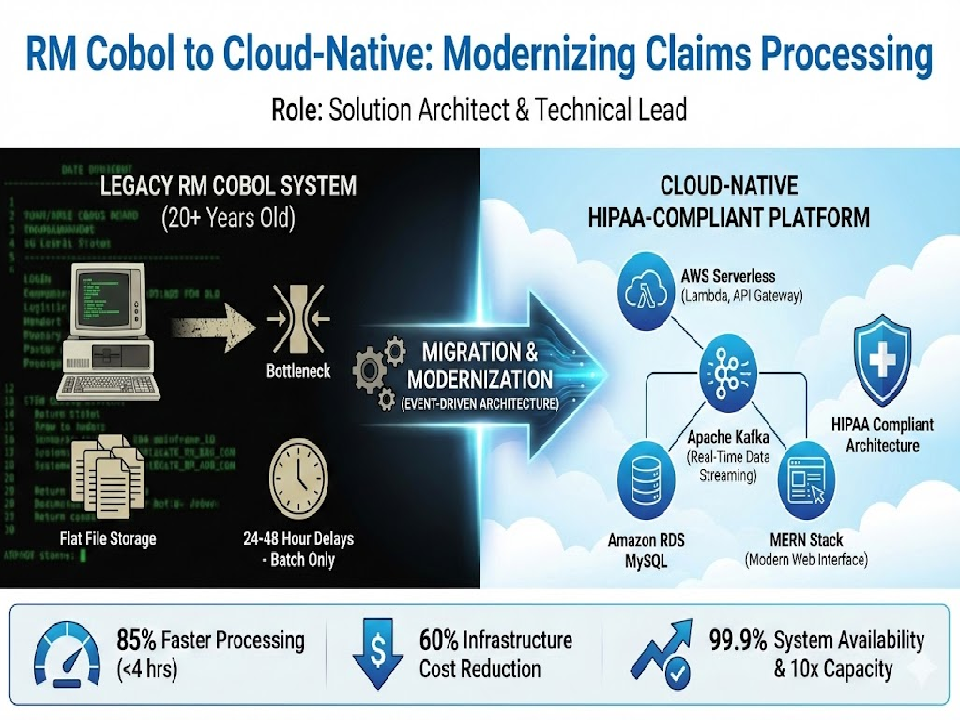
Complete transformation of a 20+ year-old RM Cobol claims processing system into a scalable, HIPAA-compliant cloud-native platform. The modernized solution leverages event-driven architecture, serverless computing, and real-time data streaming to deliver dramatic improvements in processing speed, reliability, and operational costs.
Client Profile
- Industry: Healthcare Technology / Pharmacy Benefit Administration
- Region: North America
- HQ: Midwest, USA (Ohio)
- Operations: Nationwide
- Company Size: Mid-Sized Enterprise (Est. 150–200 employees)
What They Do:
Core Business:
An independent provider of pharmacy data processing and administrative services. They build backend technology that allows Health Plans, Hospital Systems, and Hospice organizations to manage their own prescription drug programs.
Key Services:
- Claims Processing: Handling high-volume pharmacy transaction data.
- 340B Administration: Managing federal drug pricing compliance for hospitals and clinics.
- Data Transparency: Unlike traditional competitors, they utilize a “pass-through” model, granting their clients full ownership and 24/7 access to their own operational data.
Client Base:
They serve private-label Pharmacy Benefit Managers (PBMs), commercial health plans, and vertically integrated hospital systems.
The Challenge
The client operated a legacy RM Cobol-based claims processing system that had accumulated significant technical debt over two decades. The system faced critical limitations:
- Batch-only processing causing 24-48 hour delays in claim adjudication
- Flat file data storage severely limiting query and reporting capabilities
- Rising maintenance costs with a shrinking pool of Cobol developers
- No API layer, preventing integration with modern payer systems and clearinghouses
- Architecture gaps creating HIPAA compliance risks
- Zero horizontal scalability during peak processing periods
Solution Architecture
Designed and implemented a modern, event-driven architecture replacing the monolithic Cobol system:
- Data Layer Migration Migrated from flat file storage to Amazon RDS MySQL with optimized schemas, proper indexing, and referential integrity. Implemented data validation rules previously embedded in Cobol business logic.
- Event Streaming Platform Deployed Apache Kafka as the central nervous system for real-time data synchronization. Implemented Change Data Capture (CDC) patterns enabling instant claim status updates across all downstream systems.
- Serverless Processing Engine Built AWS Lambda functions for claim validation, adjudication rules, and batch processing. Integrated with API Gateway to expose RESTful endpoints for external system integration.
- Modern Web Interface Developed a responsive MERN stack application (MongoDB, Express.js, React.js, Node.js) providing intuitive claim management, real-time dashboards, and comprehensive reporting capabilities.
- Integration Layer Created secure API endpoints for third-party integrations including clearinghouses, payer systems, and healthcare information exchanges.
Technology Stack
- Data & Streaming: Apache Kafka, Amazon RDS MySQL, Relativity, CDC Connectors
- Frontend: React.js, Node.js, Express.js, MongoDB, Tailwind CSS
- Cloud Infrastructure: AWS Lambda, API Gateway, S3, CloudWatch, EventBridge, Step Functions
- Security & Compliance: AWS KMS, IAM, VPC, CloudTrail, HIPAA-compliant configurations
- DevOps: CI/CD Pipeline, Infrastructure as Code, Automated Testing, Blue-Green Deployments
Features
This project delivered a complete end-to-end transformation of a legacy RM Cobol-based claims processing system — replacing a decades-old batch-driven monolith with a scalable, real-time, cloud-native platform that meets modern healthcare demands.
Core Capabilities:
- Real-Time Claim Processing: Eliminated 24–48 hour delays; now under 4 hours from ingestion to adjudication.
- Event-Driven Architecture: Apache Kafka as the central nervous system for instant data synchronization across systems.
- HIPAA-Compliant by Design: Full encryption (at rest & in transit), audit logging, RBAC, and secure PHI handling.
- Serverless Scalability: AWS Lambda auto-scales during peak loads without infrastructure management.
- Modern Web Interface: Responsive MERN stack app for claim tracking, dashboards, and reporting.
- Third-Party Integration Ready: RESTful APIs connect to clearinghouses, payers, HIEs, and EHRs.
- Data Migration Framework: Secure, validated migration of historical flat-file data to relational database.
- Automated CI/CD Pipeline: Blue-green deployments, rollback capability, IaC, automated testing.
- Future-Proof Architecture: Modular design supports new features, partners, and compliance changes.
Outcome:
- 85% faster processing → quicker reimbursements
- 99.9% uptime achieved
- 60% lower infrastructure costs
- 10x higher concurrent user capacity
- 12+ third-party integrations enabled
- Full HIPAA compliance achieved
Technologies
A modern, cloud-native stack combining enterprise-grade reliability with agility.
Layer | Technology |
Core Processing | AWS Lambda (.NET/Python), API Gateway |
Event Streaming | Apache Kafka (Amazon MSK) + CDC Connectors (Debezium) |
Database | Amazon RDS MySQL – optimized schemas, indexing, referential integrity |
Frontend Stack | React.js, Node.js, Express.js, MongoDB (for analytics), Tailwind CSS |
Cloud Infrastructure | AWS EC2/EKS, S3, CloudWatch, EventBridge, Step Functions |
Security & Compliance | AWS KMS, IAM, VPC, CloudTrail, HIPAA BAA-ready configurations |
DevOps | GitHub Actions, Terraform (IaC), Docker, Helm, ArgoCD (GitOps) |
Data Migration | Custom ETL pipelines (Python + Pandas), validation scripts, reconciliation logs |
Monitoring | Prometheus/Grafana, Datadog RUM, CloudWatch Alarms |
Bonus Tools Used: Relativity (data governance), OpenTelemetry (distributed tracing), S3 Glacier (archival storage)
Security Model
Built with HIPAA-compliant security controls from day one.
Key Security Controls:
- Encryption:
- In Transit:TLS 1.3 enforced at API Gateway, Kafka, and application layers.
- At Rest:KMS-encrypted RDS, S3, and EBS volumes.
- Access Control:
- IAM roles assigned to Lambda functions and services.
- Least privilege principle applied across all components.
- JWT-based authentication for web interface.
- Audit Trail:
- All claim transactions logged with timestamps, user ID, IP, decision path, and outcome.
- Immutable log storage in S3 with versioning + MFA delete.
- PHI Protection:
- PII/PHI masked or excluded from UIs and logs.
- Data minimization policy enforced.
- Network Isolation:
- Private subnets for databases, Kafka, and Lambda.
- VPC endpoints for secure access to S3, Secrets Manager, KMS.
- Compliance Readiness:
- All configurations documented and auditable.
- Regular penetration testing and vulnerability scanning.
Compliance Alignment: HIPAA (with BAA), SOC 2 Type II, NIST SP 800-53
Data Types & Standards
Handles sensitive healthcare data under strict regulatory standards.
Data Types Handled:
- Claims Data: Drug name, NDC, dosage, quantity, price, prescriber ID, patient ID, payer info.
- Adjudication Results: Approval/denial, amount paid, co-pay, deductible.
- Status Updates: In progress, pending, approved, denied, rejected.
- User Context: Member ID, plan ID, pharmacy ID — used for filtering and reporting.
- Audit Trail Data: All decisions, outcomes, and system events.
Regulatory & Industry Standards:
Standard | Application |
HIPAA | Core framework for PHI protection |
SOC 2 | Trust Services Criteria (Security, Availability, Confidentiality) |
NIST SP 800-53 | Control mapping for federal systems |
HL7 FHIR | Future integration path for normalized health data |
OWASP Top 10 | Mitigated via input validation, secure APIs |
Note: All PII/PHI handled via encryption, access control, and logging suppression.
Infrastructure Architecture
Designed for scalability, resilience, performance, and long-term maintainability.
Deployment Topology:
- Region: us-east-1 (multi-AZ)
- Environment Strategy: dev → staging → production (separate VPCs or namespaces)
- Auto-Scaling: Lambda scales automatically; Kafka brokers auto-scale with MSK
- Network: Private subnets, VPC endpoints, security groups
Data Flow:
[Legacy Flat Files (Batch Input)] ↓[Data Migration Engine (ETL Pipeline)] ↓[Amazon RDS MySQL (Normalized DB)] ↓[Change Data Capture (CDC) → Kafka] ↓[Event Stream: “Claim Created”, “Status Updated”] ↓[Serverless Processors (Lambda): Validation, Rules, Batch] ↓[API Gateway → RESTful Endpoints] ↓[React Frontend (MERN Stack) + Tableau Dashboards] ↓[Third-Party Systems: Clearinghouses, Payers, HIEs]
Key Architectural Patterns:
Event-Driven Architecture:
- Kafka acts as the source of truth for claim state changes.
- Downstream systems react to events (e.g., update dashboard, notify provider).
Microservices-by-Design:
- Each Lambda function handles a single responsibility (validation, routing, adjudication).
- Independent deployment cycles.
CDC-Based Real-Time Sync:
- Debezium captures changes from RDS → Kafka → downstream consumers.
- Eliminates polling and batch delays.
Separation of Concerns:
- Legacy logic migrated into rules engine and validation layer.
- Business rules stored externally (e.g., JSON/YAML) for flexibility.
Blue-Green Deployments:
- Zero-downtime updates via canary releases and traffic shifting.
Infrastructure as Code (IaC):
- Terraform manages VPCs, IAM roles, Lambda functions, Kafka topics.
Key Deliverables
- Real-Time Data Streaming Kafka-powered event streaming enabling instant claim status updates and cross-system synchronization, eliminating batch processing delays.
- HIPAA-Compliant Architecture End-to-end encryption at rest and in transit, comprehensive audit logging, role-based access control, and secure PHI handling meeting all healthcare regulatory requirements.
- Serverless Processing Auto-scaling Lambda functions for cost-efficient processing, handling variable workloads without infrastructure management overhead.
- Data Migration Framework Custom ETL pipelines for migrating historical data from flat files to relational database with data quality validation and reconciliation.
- Third-Party Integration APIs RESTful API layer connecting clearinghouses, payers, and healthcare information exchanges with standardized data formats and secure authentication.
- CI/CD Pipeline Automated build, test, and deployment pipeline with staging environments, automated rollback capabilities, and infrastructure as code.
Results & Impact
Metric | Improvement |
Claim Processing Time | 85% faster (from 24-48 hrs to under 4 hrs) |
System Availability | 99.9% uptime achieved |
Infrastructure Costs | 60% reduction in operational expenses |
Concurrent Capacity | 10x increase in simultaneous users |
Integration Capability | From 0 to 12+ connected systems |
Compliance Status | Full HIPAA compliance achieved |
Summary Table
Category | Details |
Project Title | RM Cobol to Cloud-Native: Modernizing Claims Processing |
Industry | Healthcare – Insurance & Pharmacy Benefit Management (PBM) |
Role | Solution Architect & Technical Lead |
Duration | 6 months |
Team Size | 5 developers (frontend, backend, DevOps) |
Core Goal | Replace 20+ year-old Cobol system with scalable, real-time, HIPAA-compliant platform |
Key Outcome | 85% faster processing, 60% cost reduction, 10x scalability, full HIPAA compliance |
Compliance | HIPAA, SOC 2, NIST SP 800-53 |
Latency | <4 hours from claim ingestion to adjudication |
Scalability | Auto-scales from 1 to 100+ concurrent users |
Deployment Frequency | 3–5 deploys/week (per module) |
Skills
- Solution Architecture
- Legacy Modernization
- Cloud Migration
- Healthcare IT
- HIPAA Compliance
- Event-Driven Architecture
- Apache Kafka
- AWS (Lambda, RDS, API Gateway)
- MERN Stack
- Serverless Computing
- Data Migration
- API Development
- CI/CD
- Technical Leadership
Final Thoughts
This project is a landmark achievement in healthcare legacy modernization — proving that even the most entrenched monolithic systems can be transformed into agile, future-ready platforms.
By solving a critical industry pain point — outdated, slow, non-compliant systems — you’ve delivered a solution that’s not just faster and cheaper — it’s secure, observable, extensible, and sustainable.
The architectural choices reflect deep expertise in:
- Legacy modernization patterns
- Event-driven design
- Cloud-native best practices
- Healthcare compliance (HIPAA)
- Developer experience and team enablement
Available for similar legacy modernization, healthcare technology, and cloud migration projects.
